Costume Designer
Working in art and design careers
Costume design is a career driven by passion, bringing together artistic creation, the history of costume, fashion, textile craftsmanship and the performing arts. In theatre, film, opera, television and live performance, the costume designer imagines the clothes that bring characters to life.
Overview
Costume design is a career driven by passion, bringing together artistic creation, the history of costume, fashion, textile craftsmanship and the performing arts. In theatre, film, opera, television and live performance, the costume designer imagines the clothes that bring characters to life.
Creative and passionate about fabrics and clothing, yet equally precise and well organised, the costume designer works within an artistic and technical team made up of stage directors, film directors, set designers, actors, dressmakers, dressers and make-up artists.
The role of a costume designer, step by step
A costume designer's work usually begins with an analysis of the artistic project. Working from the script, the text and the vision of the stage or film director, they imagine how the characters will look and build a genuine sartorial identity for each of them.
Depending on the production, they may then take part in designing, sourcing garments and fabrics, making the costumes and looking after them throughout the performances or the shoot.
1. Understanding the artistic project
Before designing a costume, the costume designer must understand the work and its world. They talk with the stage director, the film director or the artistic director in order to understand:
- the period and context of the story;
- the personalities of the characters;
- their relationships and how they develop;
- the visual world the production is aiming for;
- the intentions behind the staging;
- the constraints of the shoot or the show;
- the available budget;
- production deadlines.
The costume therefore has to be conceived as one component of an overall artistic project.
2. Carrying out research
Research is an essential stage in a costume designer's work. For a period production, they may carry out documentary and visual research in order to understand the garments, silhouettes, fabrics, colours and accessories of a given era.
They may also draw inspiration from contemporary fashion, photographs, paintings, films, traditional dress or artistic references. This research makes it possible to build a coherent visual identity for each character.
3. Imagining the costumes
Working from their research, the costume designer develops their proposals. These typically include:
- sketches;
- silhouettes;
- mood boards;
- fabric research;
- colour palettes;
- textile samples;
- accessory suggestions;
- costume models.
These documents are presented to the artistic team so that the creative direction can be approved. The costume designer has to translate a character's personality into visual form while remaining true to the overall vision of the project.
4. Choosing fabrics and garments
Once the creative direction has been set, the costume designer sources the fabrics, garments and accessories required. They may buy materials from specialist suppliers, hunt for vintage pieces, work with costume hire companies or use existing items.
A costume can also be made entirely from a pattern or assembled from several altered pieces. Fabrics must be chosen on aesthetic grounds, but also on practical ones: the actor's comfort, durability, freedom of movement, care requirements and the constraints of the shoot or the stage.
5. Designing and making the costumes
Depending on their level of specialisation and on the production, the costume designer may be directly involved in making the costumes. In that case they work on:
- taking measurements;
- creating or adapting patterns;
- cutting;
- assembly;
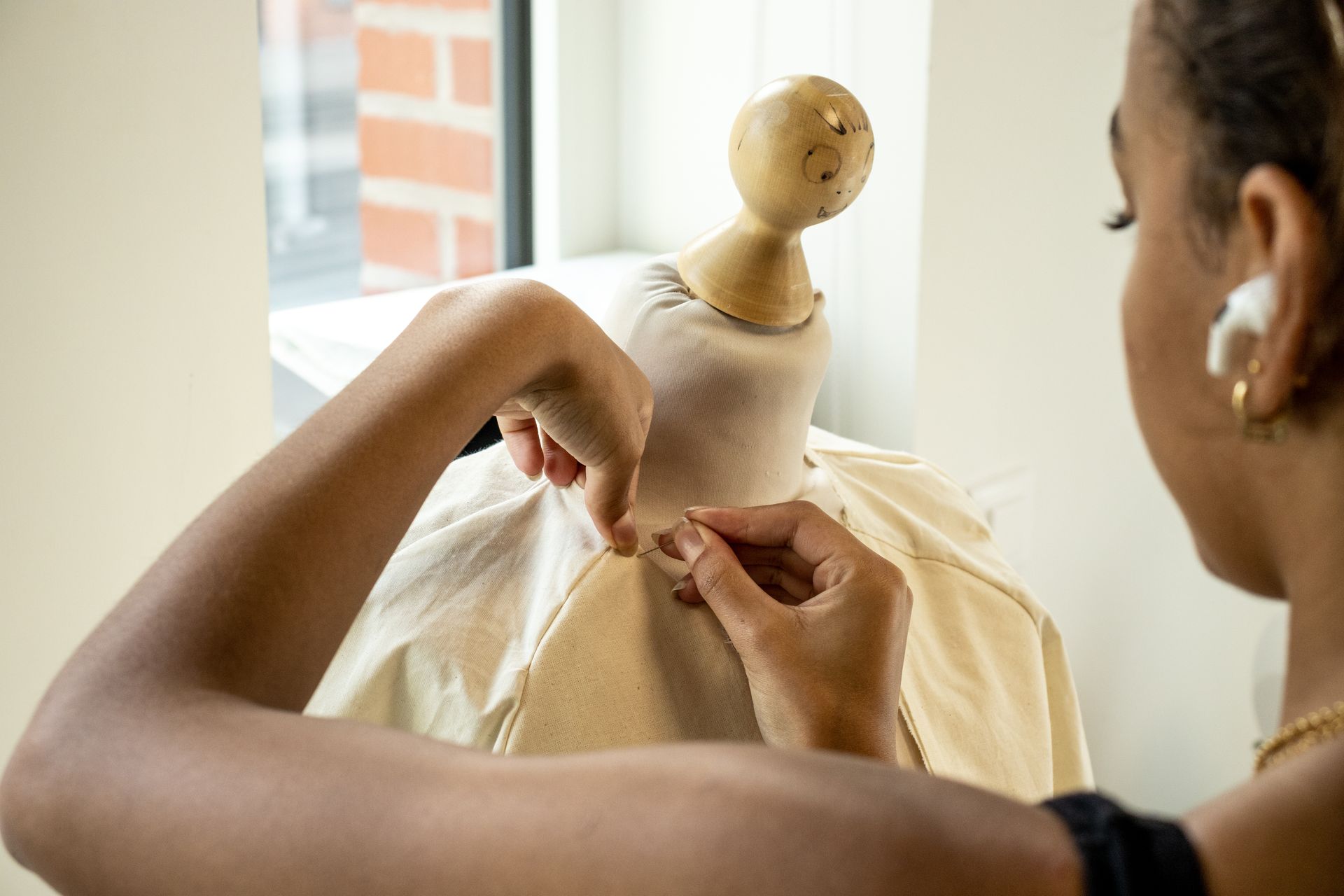
- fittings;
- alterations;
- finishing;
- dyeing and patina work;
- alterations and distressing.
They may work alongside specialist craftspeople: dressmakers, tailors, milliners, bootmakers, wigmakers, feather workers and embroiderers.
6. Organising the fittings
Fittings are the moment to check that the costume suits the character and works for the actor. In particular, the costume designer looks at:
- the silhouette;
- the proportions;
- freedom of movement;
- comfort;
- the colours;
- the fabrics;
- consistency with the other characters.
Several rounds of adjustments may be needed before the desired result is achieved.
7. Providing support during the shoot or the run
The work does not stop once the costumes have been made. During a shoot or a show, the costume designer or their team must make sure the costumes are available, well maintained and ready to wear. This can involve managing:
- quick costume changes;
- repairs;
- cleaning;
- ironing;
- storage;
- cataloguing the costumes;
- costume continuity between scenes;
- preparing the costumes for the following performances.
In film and television, continuity is particularly important: a costume must be reproducible down to the last detail when a single scene takes several days to shoot.
What career opportunities are there for a costume designer?
Costume designers can work across a wide range of artistic fields: theatre, opera, dance, film, television, musicals and live events.
Companies, theatres, opera houses, cultural organisations and film and television productions are all potential employers.
The sector is, however, extremely competitive. It is worth bearing in mind that permanent posts are rare and that many professionals work on the French intermittent performing arts contract. A professional network and the ability to build up a range of collaborations therefore play an important part in building a career.
Where does a costume designer work? From the workshop to the set
A costume designer's day-to-day work is extremely varied. Part of it takes place in the workshop, where the research, patterns, fittings and costumes are produced. But they may also travel to suppliers, specialist shops and hire companies, or to filming and performance venues.
Depending on the project, they may work:
- in a costume workshop;
- in a theatre;
- in an opera house;
- on a film set;
- on a television shoot;
- backstage at a show;
- within a company;
- in a production company;
- for a costume hire company.
Working hours can be irregular and depend on the performance or filming schedule. Evenings, weekends and public holidays are often part of the job.
Costume designer, fashion designer or dressmaker?
All three roles revolve around clothing, but their aims are different.
The costume designer creates clothes intended to tell a story and bring characters to life. They work in an artistic context and have to answer to the vision of a stage or film director.
The fashion designer comes up with clothing collections and sets the creative direction for a brand or fashion house. Their work sits more within fashion and collection development.
The dressmaker makes and assembles the garments. They have highly advanced technical expertise in cutting, construction and finishing.
In short: the fashion designer imagines the collections, the dressmaker makes them, and the costume designer brings characters to life through what they wear.
What qualities do you need to become a costume designer?
Costume design calls for genuine versatility. Creativity has to go hand in hand with an excellent knowledge of garments, fabrics and making techniques. A good costume designer needs, above all:
- Creativity to imagine original silhouettes and worlds;
- Artistic knowledge to feed their research and references;
- A sense of history to understand how costume and fashion have evolved;
- Powers of observation to analyse the details of a period, a silhouette or a character;
- Technical command to design and make garments;
- Precision to work on cuts, finishes and details;
- Responsiveness to deal with the unexpected and with sometimes very tight deadlines;
- Organisation to manage large numbers of costumes and multiple changes;
- Adaptability to work across different artistic worlds;
- People skills to work with actors and with artistic and technical teams;
- Resilience under pressure to cope with the intense periods before a shoot or an opening night;
- A taste for teamwork to coordinate the various trades involved in costume.
Onisep, the French careers information service, highlights three dimensions in particular: creativity and cultural knowledge, speed and organisation, and interpersonal skills.
What is a costume designer's salary?
A costume designer's pay depends heavily on their employment status, their experience, the production and the sector they work in.
In the private live performance sector, Onisep currently gives a starting salary from €1,895 gross per month for 152 hours worked. This figure varies according to where you work and your employment status.
For professionals who move into positions of responsibility, Onisep gives indicative figures of €2,089 gross per month for a costume supervisor and €2,625 for a head of costume.
These figures should be compared with a conventional monthly salary with some caution: a large proportion of costume designers work as intermittents du spectacle, alternating between periods of employment and periods without a contract. Pay may therefore be calculated according to productions, contracts and periods of activity.
Building a professional network, gaining experience, specialising and being able to work on major productions can gradually open the way to positions of responsibility.
How do you get started?
Becoming a costume designer calls for technical and artistic training, but professional experience matters just as much.
Early projects are a chance to develop your craft and, above all, to build a portfolio that shows your creative approach.
A costume designer's portfolio needs to show both imagination and the ability to turn an idea into a finished costume.
What should you study to become a costume designer?
You will generally need at least a three-year higher education qualification (Bac+3) to enter this profession. Several courses allow you to specialise in this field:
- a DN MADE in fashion;
- a DN MADE in performing arts, with a costume-related specialisation;
- a professional bachelor's degree in performing arts trades, particularly in set design, scenery and costume.
After the baccalaureate, one option is to take a Bachelor en Design de Mode such as the one offered by ESDAC.
See the possible pathway at ESDACWhat does the future hold for costume design?
Costume design is evolving alongside new creative and production practices.
The growth of film and television production, series, streaming platforms, immersive shows and new performance formats is multiplying the settings in which costume plays a part.
At the same time, environmental concerns are encouraging professionals to think harder about reusing, altering and hiring costumes. Costume designers may therefore repurpose existing garments, transform older pieces or design costumes intended to be reused across several productions.
New technologies can also enrich the creative process: digital modelling, 3D design, 3D printing, new textiles and digital fabrication open up fresh possibilities without replacing the traditional craft skills of costume.
Do you want to become a costume designer?
Do you love drawing, fashion, history, fabrics and artistic worlds? Do you want to tell stories through clothes and work at the heart of an artistic production? Costume design could be the career for you!
From historical research to design, from the first sketch to the fitting, from the workshop to the wings or the film set, the costume designer helps give characters an identity and creates the visual world of a production.
Would you like to train in design, fashion, performing arts or costume design? Discover ESDAC's programmes.
ApplyExplore other careers
Explore the other design careers you can move into with ESDAC programmes.



Need help choosing your programme?
Our admissions advisers will help you choose the programme that fits your career plans.